LiK Conference 2026
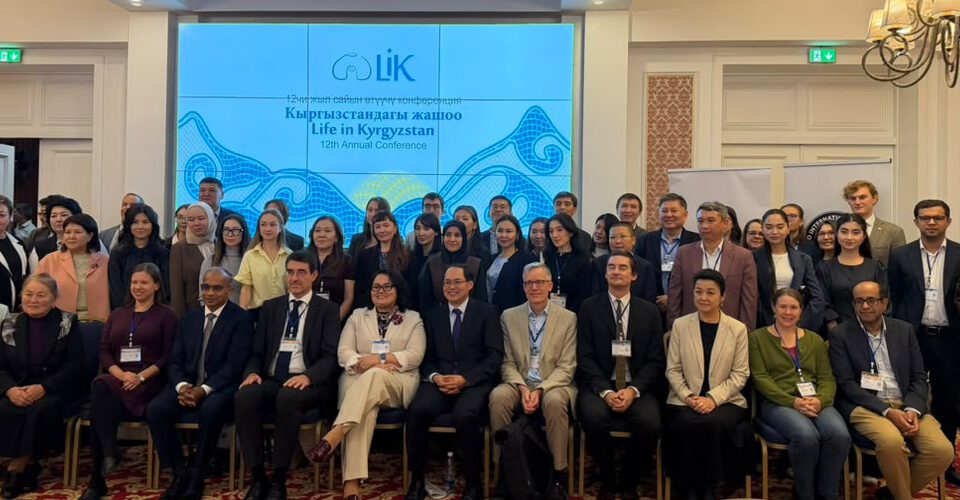
12th Annual Life in Kyrgyzstan Conference
07-08 October 2026, Orion Hotel, Bishkek
The detailed program in English in PDF can be downloaded here: LiK Conference 2026 program.
Программа конференции на русском языке доступна здесь: Программа ЛиК конференции.
The LiK Conference 2026 brochure: LiK Conference 2026 brochure.
The picture gallery from the conference can be seen here: LiK Conference 2026 Album
Day 1: October 07, 2026
OPENING REMARKS
Moderator: Asel Murzakulova, UCA
* Eran Edirisinghe, Dean of Research, UCA
* Zarylbek Kudabaev, Chair of Economics Department, AUCA
* Nazira Esenalieva, Rector, AIU
* Hugh Riddell, Country Manager, World Bank Group
* Tilman Brück, Professor, Humboldt University, IGZ, ISDC
PLENARY SESSION 1.1 Keynote Speech
Moderator: Kanat Tilekeyev, UCA
Dr Damir Esenaliev, IGZ/ISDC: Welfare and Social Cohesion: Two Decades of Research in Kyrgyzstan
SESSION 1.2 Migration, Households and Economic Change in Central Asia
Moderator: Anwar Naseem, UCA
– Bakhytzhan Kurmanov, UCA: Migration Patterns of Central Asian Rural Youth in the Context of Russia-Ukraine Conflict
– Ulugbek Tursunov, Social Policy Lab; Yonsei University: Exposed Abroad: The 2022 Ruble Crash and the Welfare of Remittance-Dependent Households in Uzbekistan
Feruza Jurayeva, New Uzbekistan University: Climate Change as a Driver of Migration in Central Asia and the Caucasus: Evidence from Structural Equation Modeling Using the Life in Transition Survey IV
SESSION 1.3 Negotiating Uncertainty: Everyday Responses to Social Change in Kyrgyzstan
Moderator: Mehrigiul Ablezova, PIL Research Company
– Gulnara Ibraeva, PIL Research Company: Constructing Employability: Evidence from Job Advertisements
– Mehrigiul Ablezova, PIL Research Company: Competing Visions of Work: Mapping Labour Value Archetypes through Q-Sort in Kyrgyzstan
– Anastasiia Danshina, PIL Research Company: Living with Contradictions: Labour Values in Contemporary Kyrgyzstan
Elnura Omurkulova-Ozierska, PIL Research Company: Emerging Forms of Work and Social Protection Gaps in Kyrgyzstan: Assessing Coverage, Vulnerability, and Policy Options
SESSION 1.4 LiK partners and donors meeting: This session was devoted to the future of the LiK Study and its funding
SESSION 1.5 World Bank session: Growth, Poverty, and Labor Market Dynamics
Moderator: Aibek Ashirov, World Bank
– Aibek Ashirov, WB: Listening to the Kyrgyz Republic: High-Frequency Evidence on Household Well-Being Amid Rapid Economic Growth
Aphichoke Kotikula, WB: Poverty Dynamics in the Kyrgyz Republic: From Rapid Poverty Reduction to Emerging Vulnerabilities.
Damir Esenaliev, ISDC / IGZ: Short- and Long-term Impacts of Center-based Childcare on Maternal Work: Evidence from Kyrgyzstan
SESSION 1.6 Evidence-Based Policy and Green Economy Modelling in Kyrgyzstan
Moderator: Manas Kadyraliev, Green Economic Modelling Center
– Saikal Esenamanova, CEMA/KEU: Introduction to the Center for Economic Modeling and Analysis (presentation)
– Azhar Zholonbaeva, CEMA/KEU: Improving Air Quality through the Transition to Clean Transport, Decarbonization of Heating Systems, and Expansion of Green Areas (presentation)
– Kubanychbek Sagaliev, CEMA/KEU: Improving Soil Fertility through Crop Rotation, Irrigation, Precision Agriculture, and the Introduction of Sustainable Agricultural Technologies (presentation)
– Omar Dairov, CEMA/KEU: Scenario Analysis of Decarbonization and Modernization of the Bishkek Thermal Power Plant (presentation)
SESSION 1.7 Gender, Institutions, and Public Policy in Kyrgyzstan
Moderator: Aizirek Erkebaeva, International Youth Council on Gender Equality (IYCGE)
– Aizirek Erkebaeva and Aidana Usupkodzhoeva, IYCGE: The Role (and Limits) of Law Enforcement in Addressing Gender-Based Violence
– Tolgonay Kalchoroeva and Akylai Anarbekova, IYCGE: Normalization and Depoliticization of Femicide in Criminal Proceedings
– Ayana Orozbaeva, IYCGE: Before the Harm: AI-Facilitated Image-Based Sexual Abuse and Legal Preparedness in Kyrgyzstan
– Elvira Isaeva, Ministry of Economy and Commerce of the KR/ Ritsumeikan University: Leadership and public service motivation: The roles of leaders’ gender and gender-stereotypical attributes
SESSION 1.8 Resilience, Trust, and Social Cohesion among Youth in Kyrgyzstan (GIZ PREVECA Project)
Moderator: Tilman Brück, HU/ISDC/IGZ
– Stefan Buchmayer, GIZ PREVECA: The PREVECA Project: Design, Activities, and Integration with Research
– Adinai Zhanybaeva and Asyl Sagynbaeva, SPEAK4PEACE (Naryn), PEACEMAKERS (Osh): From Participants to Practitioners: PREVECA Summer Camp Alumni on the Challenges and Opportunities of Implementing Youth-Led Projects
– Mirajidin Arynov, GIZ PREVECA: From Summer Camp to Youth Initiatives: Practical Experience from PREVECA
– Wolfgang Stojetz, ISDC: Youth, Resilience, and Social Cohesion in Kyrgyzstan: Quantitative Evidence from the Life in Kyrgyzstan Survey on PREVECA Themes
– Philipp Schroeder, Nazarbayev University: Understanding Youth Perspectives through Event-Based and Applied Qualitative Research: Comparative Insights from the GIZ-PREVECA Summer Camps 2025 and 2026
SESSION 1.9 Session by UNFPA: Demography and Population Dynamics
Moderator: Asel Turgunova, UNFPA
– Nagima Ulanova, Kyrgyz-Turkish Manas University: Household Living Conditions and the Transition to Clean Fuels in the CIS: The Role of Energy Integration and Socio-Demographic Inequalities
– Uulzhan Nasirdinova, Osh State University: Academic Tourism, Educational Migration, and Their Multiplier Effects on the Socio-economic Development of the city of Osh and the Southern Region of the Kyrgyz Republic
– Eldar Abdimanapov, KEU: Urban Population Growth and Motorization in Bishkek: A Statistical Analysis of Transport System Imbalances
– Nikita Ryazantsev, KRSU: Digital Nomads as a New Form of Mobility in Central Asia: Socio-Demographic Aspects
SESSION 1.10 Session by AIU: Educating Citizens in Times of Change: Youth, History, Civic Education, and the Future of Higher Education in Kyrgyzstan
Moderator: Medet Tiulegenov, AIU
– Aikerim Sagynbekova, Ala-Too International University: Character Education and the Civic Mission of Higher Education in Kyrgyzstan in the AI and Industry 5.0 Era
– Aida Kurbanova, Civic Participation Fund: Kyrgyzstan’s Youth and Its Level of Citizenship
– Ainuru Zholchieva, Ala-Too International University: Youth in Times of Uncertainty: Future Anxiety, Civic Values, and the Role of Higher Education in Kyrgyzstan
– Timur Nadyrshin, Ala-Too International University: World and National History through the Eyes of Students of the Kyrgyz Republic: Hierarchy of Interest, Figures, and Sites of Memory
– Medet Tiulegenov, Ala-Too International University: Teaching Civic Education in Authoritarian Settings
PLENARY SESSION 1.11 Intellectual Economy as a New Driver of Growth in Kyrgyzstan: Empirical Data, Public Policy, and the Synergy of Science and Business
Moderator: Kemel Toktomushev, UCA
– Aziz Abakirov, High-Tech Park: Scaling Dynamics and Human Capital in the High-Tech Park
– Daniyar Amanaliev, Ololo Group: The Intelligent Economy and the Role of the Creative Industries Park
– Elnura Kazakbaeva, Research company Evidence Central Asia: Empirical Results of the Second Wave of the Study “Who Drives Kyrgyzstan’s Creative Industries”
Almaz Chanachev, EPAM: Aligning Global Standards with Local Human Capital
Nazira Esenalieva, AIU: Research, Innovation & Entrepreneurship: From Knowledge to Policy and Business Impact
This year’s conference was convened by the University of Central Asia’s (UCA) Institute of Public Policy and Administration, the Leibniz Institute of Vegetable and Ornamental Crops (IGZ), and ISDC – International Security and Development Center, with the support of the American University Central Asia (AUCA), Alatoo International University (AIU), the United Nations Population Fund (UNFPA), and the World Bank.
This year’s keynote speakers were Dr. Olga Popova, Leibniz Institute for East and Southeast European Studies (IOS), and Dr. Damir Esenaliev, IGZ and ISDC.
The conference was held in Orion Hotel in Bishkek on 07-08 October 2026. In addition to keynote speeches and two days of thematic panel sessions, the conference included an academic seminar, professional and academic networking opportunities, and the conference reception. The Life in Kyrgyzstan Conference brings together national and international experts from academia, government, development agencies, non-governmental organizations, media and research institutions. The annual LiK Conference serves as a platform for exchanging leading-edge knowledge and experiences on recent socio-economic and environmental developments in Kyrgyzstan and Central Asia, with the aim of promoting evidence-based policy making.
The academic committee comprised of Prof. Kathryn Anderson (Vanderbilt University), Aibek Ashirov (World Bank), Prof. Tilman Brück (IGZ/HU/ISDC), Dr. Ablay Dosmaganbetov (UCA), Dr. Damir Esenaliev (IGZ/ISDC), Dr. Baktybek Kainazarov (UNFPA), Dr. Aizharkyn Kozhobekova (AIU), Dr. Kanat Tilekeyev (UCA), and Dr. Nurgul Tilenbaeva (AUCA).
Please use this email address if you have any questions: likconf@gmail.com.
Organising Institutions
University of Central Asia’s Institute of Public Policy and Administration was established in 2011 to strengthen public policy in Central Asia. It provides in-depth analysis on current and emerging policy issues facing the region and improves the analytical capacity of governments and civil society to use evidence in decision-making processes. The Institute produces analytical policy papers, policy briefs and peer-reviewed research papers on social and economic issues, public administration and public policy relating to Central Asia and Afghanistan. For more information visit: http://ucentralasia.org/ippa
IGZ – Leibniz Institute of Vegetable and Ornamental Crops carries out basic and applied research supporting the sustainable production of vegetable and ornamental plants and the rational use of natural resources. It contributes to understanding fundamentals of horticultural and plant science, sustainability in production and use of plants, healthy nutrition and wellbeing of the population. Its work involves publications in high-ranking scientific journals and acquisition of competitive grants. For more information visit: http://www.igzev.de/.
ISDC – International Security and Development Center is a non-profit academic institute based in Berlin, Germany. It conducts research to improve lives shaped by violent conflict, fragility and humanitarian emergencies, providing policy advice and building capacity on international security and socio-economic development. We are unique in the global research scene for being dedicated to work exclusively on the security-development nexus. For more information, visit: https://isdc.org/.
Partner Institutions
American University of Central Asia (AUCA) is a multi-disciplinary learning community in the American liberal arts tradition with the mission of developing enlightened and impassioned leaders for the transformation of Central Asia. With a current enrolment of approximately 1,500 students from over 25 countries, AUCA offers students a quality education based on an American college model with a credit-hours system, a liberal arts curriculum, and a commitment to freedom of expression and inquiry. The University offers 14 undergraduate educational programs and 9 graduate programs. For more information on AUCA, please visit https://www.auca.kg
Ala-Too International University (AIU) is one of the leading international universities in Central Asia. Established in 1996, the University is recognized for its excellence in teaching and research. Its mission is to educate well-rounded professionals equipped with relevant knowledge, strong critical thinking skills, and the ability to adapt to rapidly changing environments. AIU comprises five faculties, 22 departments, one professional college offering six academic programs, 10 master’s programs, and five doctoral programs, serving over 4,600 students. The University’s two research centers and academic journals actively contribute to regional and national research development. For more information on AIU, please visit: https://alatoo.edu.kg.
UNFPA is the United Nations agency dedicated to sexual and reproductive health. Its core mission is to foster a world where every pregnancy is desired, every childbirth is safe, and every young person’s potential is realized. Since 1992, UNFPA has been actively involved in the Kyrgyz Republic, supporting the population and housing censuses, provision of reproductive health supplies, and the enhancement of national capabilities in integrated sexual and reproductive health services, as well as youth-friendly health services. For more information visit https://kyrgyzstan.unfpa.org/en
The World Bank is an international organization dedicated to providing financing, advice, and research to developing nations to aid their economic advancement. Since the Kyrgyz Republic joined the World Bank in 1992, the Bank’s financial assistance has amounted to over US$2,024 million. The World Bank support has helped the country to maintain macroeconomic stability, invest in strategic infrastructure, and improve access to social services. For more information visit https://www.worldbank.org.